
Design before you cut
sketchbook
The Dressmaker sketchbook is where you design and colour a dress, pinning fabric samples and appliqué before you cut a single panel. Steam extras put this step after you have chosen cloth and before you arrange pieces on the table, so the drawing is a plan, not a souvenir of a finished garment.
Screenshots of the sketchbook show requirements, garment pieces, fabric choices, and dress attributes on one spread. That is the same information architecture the loop uses: what the client asked for, which pieces exist, which samples you clipped to the page, and how the dress should read when it later hangs on the mannequin. Spend time here before you spend silk; a recut on the table costs a roll, a recut on paper costs a pencil. Launch notes put more than 150 dress pieces in the full game, and this spread is where you pick which of those pieces actually go onto the form. Colour the pieces here, then prove them on the mannequin after the cut. If the spread and the form disagree, trust the form and recut.
Design, colour, and samples
You colour the dress in the book, then attach fabric samples so the page carries the real hand you bought in the emporium. Cotton, linen, wool, silk, and velvet all clip in as samples; the sketch does not replace the stock. If you colour a panel silk and then cut it in wool, the table still wins, because arrangement is what appears on the final dress.
Appliqué can be attached in the sketchbook. That is the early version of the decoration step: you decide a motif belongs on the garment before scissors touch the roll. Later you will place buttons, bows, and lace with more freedom, but the sample on the page is the promise you make to yourself about where a patch should live.
Colour here is also thread colour planning. The infinite bobbin means you can pick a stitch that matches the sample or fights it. Decide on the page so you are not improvising under the vintage head with a client at the bell.
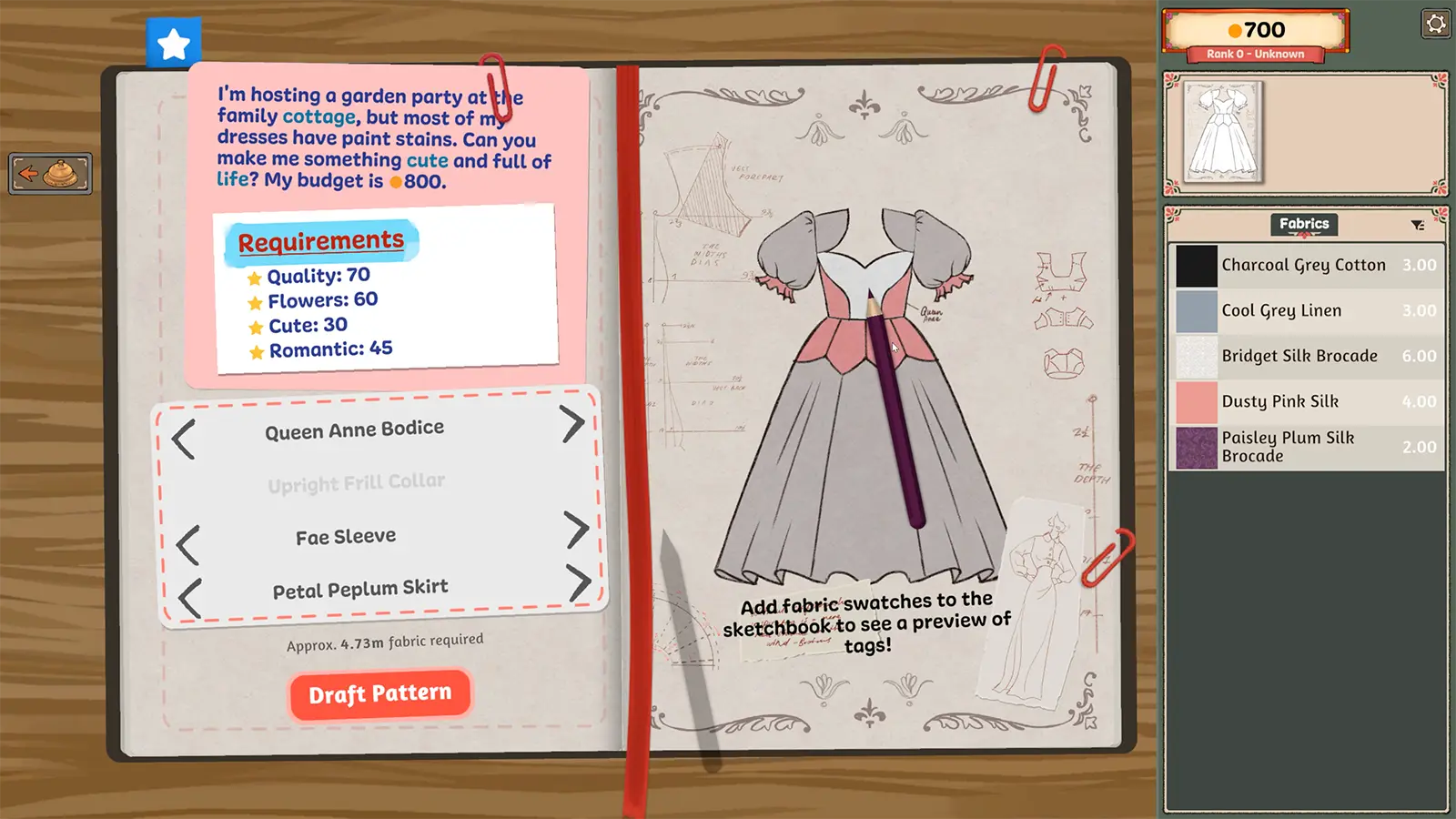
Client requirements on the page
Townsfolk commission dresses for events and tastes. The sketchbook is where those constraints should be visible while you draw: a length, a formality, a colour the client will actually wear. Steam does not publish a full quest log of every request, but the ten major-commission names in achievements are a reminder that some jobs are longer than a single sketch.
Measurements live on the person, not only on the page. April Tea says each character is measured and the mannequin follows. Use the book to pick a silhouette, then confirm it on the form after you cut. A beautiful sketch that ignores Priya's measurements is still a recut.
If you sell off of the rack instead, the sketchbook is how you stock a silhouette you like without a client in the room. Design a grain-stable day dress, sew it, and move it to the shop window while you take the next named commission.
Why the book comes before the table
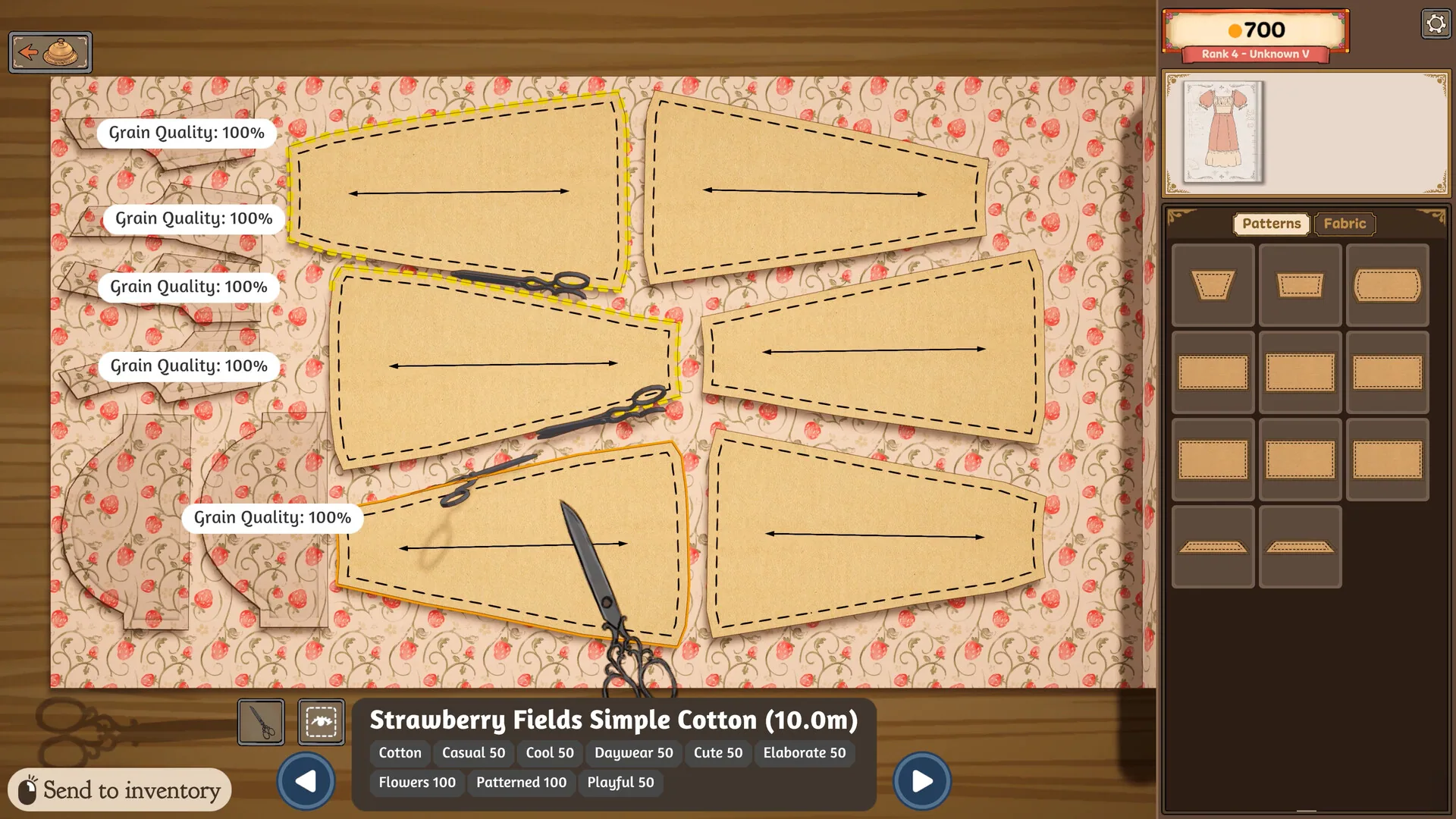
Cutting without a sketch wastes cloth you already paid for. The official loop order is choose fabric, sketch, cut, sew, decorate, deliver or sell. Skipping the book means you discover the neckline on the mannequin after the roll is already in pieces.
Bias decisions belong on the page too. If the sketch wants a fluid skirt, you are committing to cut on bias later; if it wants a structured bodice, you are committing to grain. Write that into the drawing so the table is execution.
When the spread looks right, the next desk is pattern cutting. Take the samples with you in your head: the panel that was silk on the page should be the silk panel on the cloth.
From sketch to shop
Nothing in the sketchbook sews itself. You still feed panels through the sewing machine and you still place appliqué as physical extras. The book is the cheap iteration layer; the table and the machine are the expensive ones.
Hidden achievements may gate on specific sketches, but their descriptions stay Hidden on Community Page until unlock. Do not treat a blank row as a missing sketchbook mode.
Prototype 0.5.5 on itch.io also has a making loop, but it is not this Steam sketchbook. If you are learning the live game, stay on the 21 September 2026 release and Build 403.
Garment pieces on the spread
Launch notes claim more than 150 dress pieces in the full game. The sketchbook is where those pieces are chosen and coloured before they become cut panels. You will not find a public 150-row table; you will find them on the spread as you design.
Requirements, pieces, fabric choices, and attributes sharing one notebook is why this wiki treats the sketchbook as a system page rather than a gallery. If a piece is missing on the form, look back at the book before you blame the sewing machine.
Appliqué attached on the page should still be placed again as a physical extra after sewing. The sample is a plan. The decoration step is the placement. Keep a note on the spread for grain versus bias so the cutting table is not guessing, and clip the actual cotton or silk sample you intend to buy rather than a neighbour's leftover scrap.