
Buttons, bows, appliqué and lace
appliqué
Dressmaker lets you decorate with buttons, bows and appliqué, then add lace trims anywhere on the garment after sewing. Steam store extras treat that placement as complete creative freedom rather than a slot list: the accessory goes where you put it on the finished panels, not into a fixed necklace bone. Launch notes claim more than 350 accessories in the full game; the families and goals below are the ones the store and achievement list actually name.
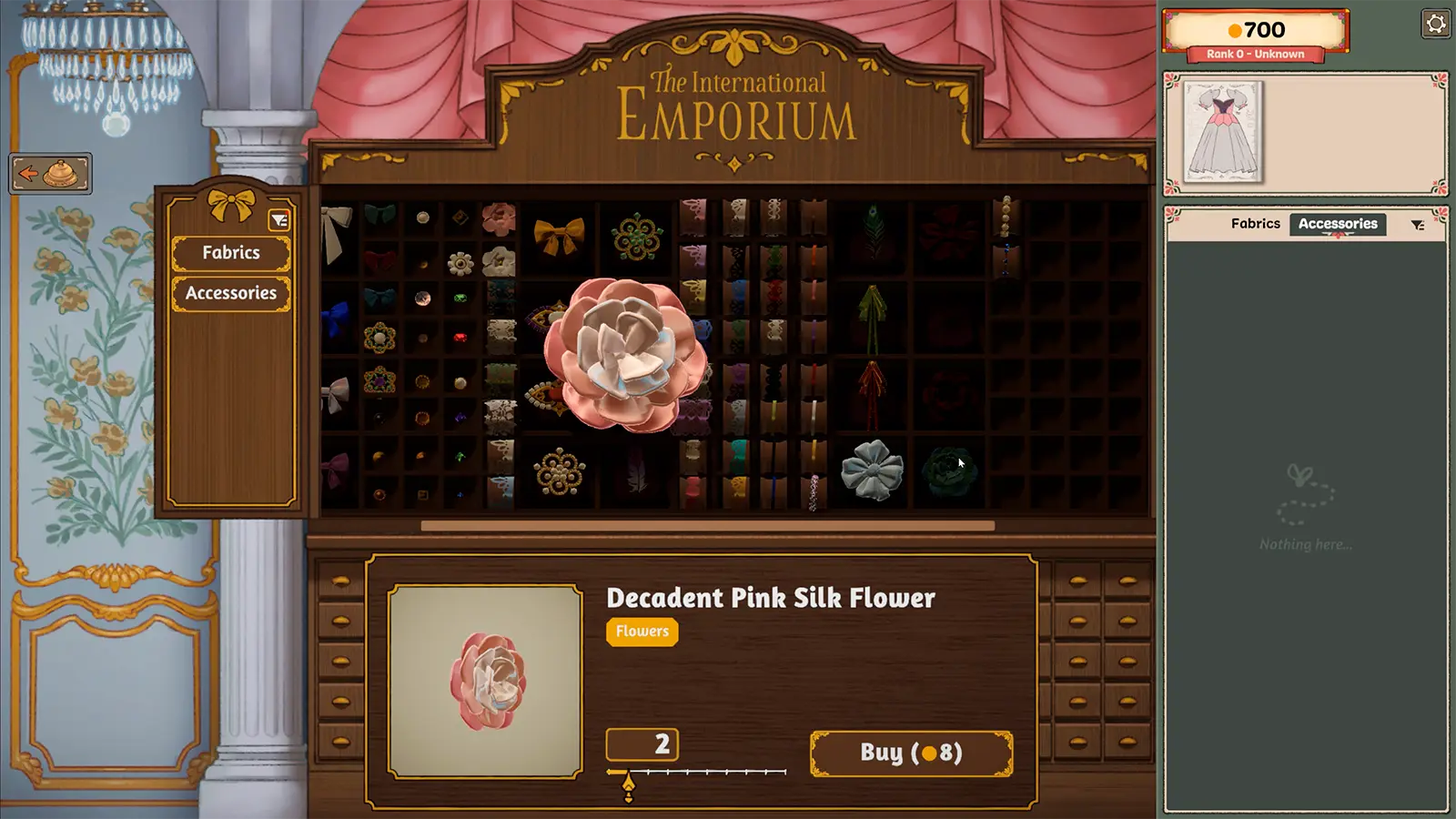
You decorate after the vintage machine has joined the cloth. A bow on an unsewn panel is not the loop. The International Emporium still from the press kit shows drawers of trims and findings, which is the shop language for this step: you buy the extra, then you place it.
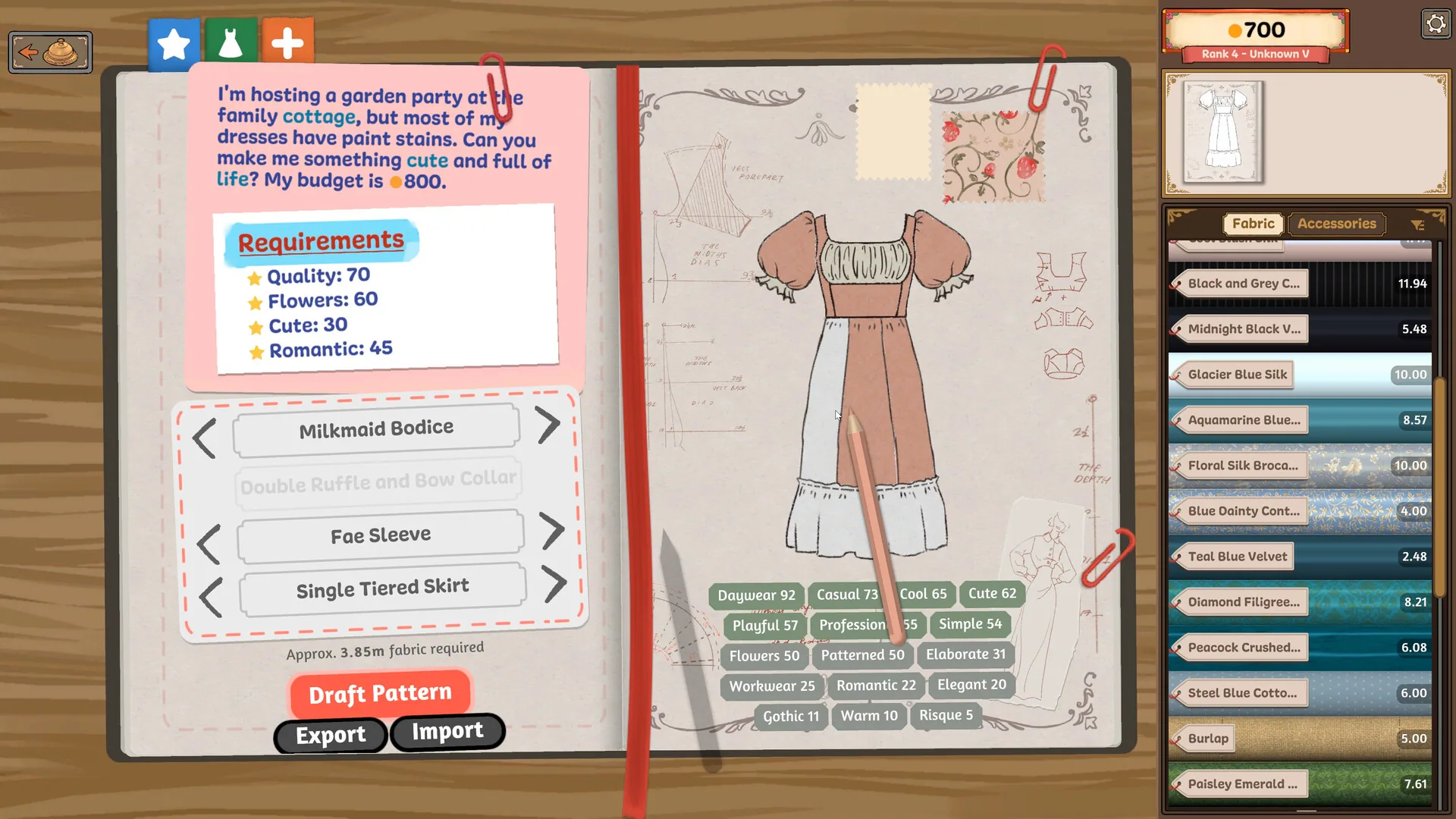
Buttons, bows, appliqué, and lace trims
Official copy lists buttons, bows and appliqué as the headline decorations, then lace trims and other accessories with freedom to put them anywhere on the garment. Appliqué is the on-page phrase because it is the named add-on you pin in the sketchbook before you ever cut, then see again here as a placed piece. A lace trim is a length, not a sticker: it follows an edge you already sewed.
Build 403 retagged lace trim inside the shop. That is a bookkeeping patch, not a new trim type, but it tells you lace is a first-class material the studio had to rename so the till and the workroom agreed. If a lace edge looked mis-categorised at launch, this is the build that tried to correct the tag.
Because placement is free, you can overload a dress. Two achievements make that concrete: Trim and Proper asks you to use more than 50m of trim on a single dress, and Harder than it Seams asks you to place over 300 accessories on one dress. Those are visible community descriptions, not hidden rows.
How trims sit on grain and bias
Decorations inherit the cut underneath. A 50-metre trim on a bias hem pulls a different silhouette than the same length on a grain skirt. The mannequin will show that sag before you deliver, which is why the cutting step still matters after you have fallen in love with a drawer of lace.
Appliqué that you attached as a sketchbook sample should land on a stable field if it is heavy. Silk and velvet already have custom shaders for shininess; stacking sequins, bows, and lace on a shiny bias panel is allowed, and Opulence and Excess even pays you for spending more than 5 000 gold on a successful dress. Allowed is not the same as flattering on every client measurement.
Buttons and bows are point placements. They do not consume metres, but they do count toward the 300-accessory goal if you choose to chase it. Nothing in the store says you must. Most commissions will want a handful of well-placed findings, not a world-record trim spool.
Where the extras live
The press screenshot of accessory drawers is the International Emporium, the same shop language used for fabric rolls. You buy decorations as stock, then spend them onto a dress. Launch-price news is the source for the 350+ accessory count; Steam's public page does not enumerate those 350 names, so there is no invented SKU roster here.
If you are shopping for a major commission, buy with the client in mind. Alice, Rose, Dorothy, and the rest of the ten named townsfolk have events and tastes; a funeral-ready lace and a festival bow are not interchangeable even if both are 'trim'. The achievement text only tells you to complete their major commissions, not which drawer to open.
Off-the-rack dresses in the shop window can wear leftover trims. A staple grain dress with modest buttons can sit in the window while you spend the exotic lace on a named client's evening piece.
Delivery after the last bow
When the garment is decorated, you either turn it in for reputation and coin or you sell it off of the rack. Build 403 makes you ring the shop bell to summon the next customer, so decorations are not the last input on a busy day — the bell is. Failed work that the shop still accepts now pays, which includes decorated dresses that missed the brief.
Style Goals and several other rows stay hidden on the community page, so do not treat a missing description as a missing decoration system. The visible craft goals are quality, trim length, accessory count, gold spend, pigeon mail, and the ten major-commission names.
If you want the next mechanical page after this one, go back to named fabric families or forward to town commissions. The decoration step is the last making action before those two money paths split.
Catalogue size versus named extras
Scalding September Tea is the source for more than 350 accessories and more than 150 dress pieces. Those counts describe the full Steam game, not a public spreadsheet. Buttons, bows, appliqué, and lace trims are the named families on the store; sequins appear in April Tea as a shader example rather than as a store-family label.
If a trim has a name in the emporium UI, it still needs a first-party page before it deserves a slug. Until then, shop by the four named extras and the two numeric achievements.
Prototype 0.5.5 may contain fewer drawers. This page is the Steam catalogue promise, not the three-week itch zip.